
.png)
Hydraulic Hose Routing Best Practices: 10 Mistakes That Lead to Premature Failure
Hydraulic hose routing may look like a minor installation detail. As long as the hose reaches from one connection point to another without leaking, it is easy to assume the job is finished.
But “connected” does not necessarily mean “correctly installed.”
A hose can be the right size, pressure rating, and material for an application, and still fail prematurely because of how it is routed. Excessive bending, twisting, abrasion, heat, poor support, and machine movement can gradually weaken the hose assembly until it begins leaking.
That makes hose routing more than a matter of keeping an installation neat. It directly affects equipment reliability, maintenance costs, operator safety, and hydraulic system performance.
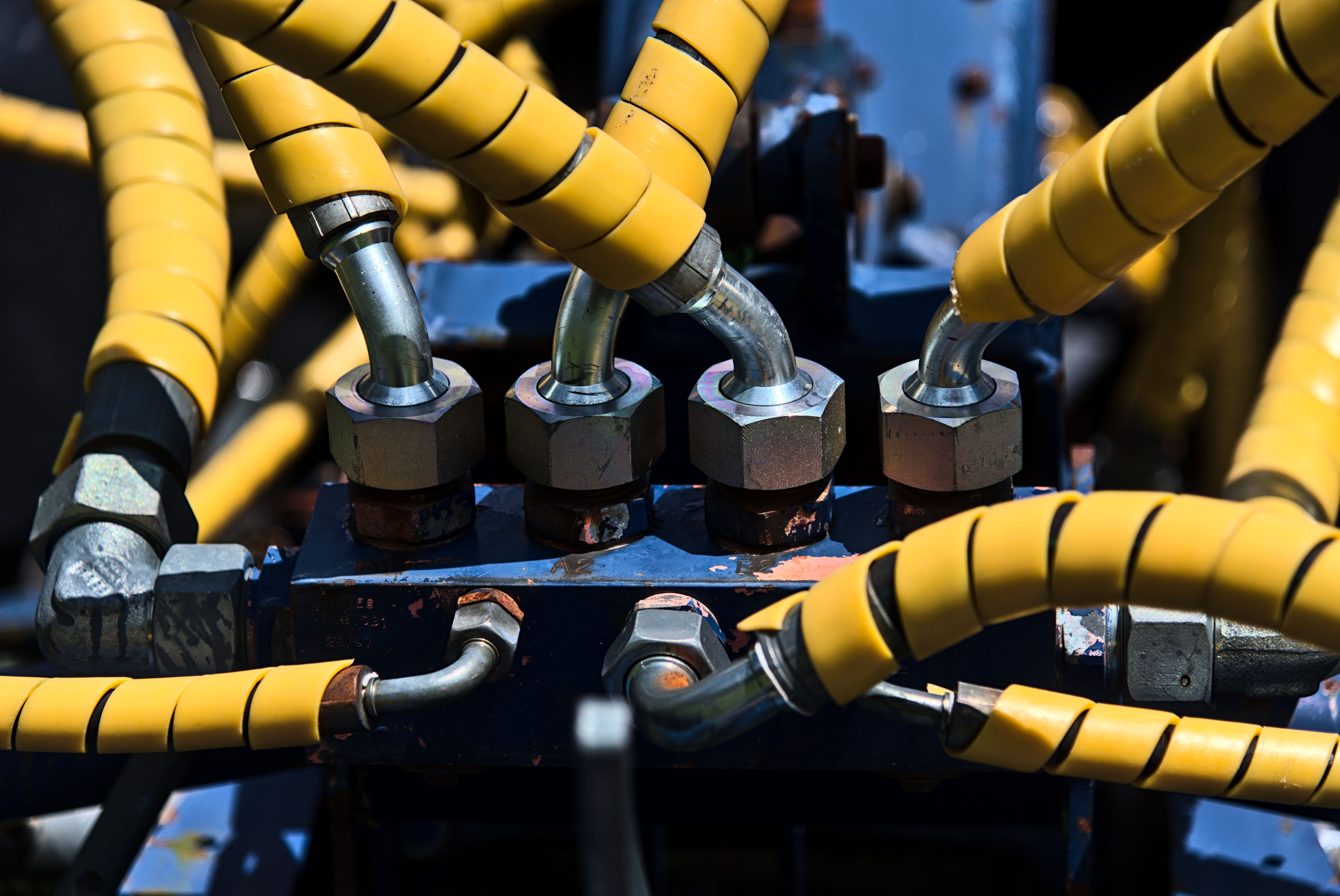
Here are 10 common routing mistakes that can significantly shorten hydraulic hose life.
1. Installing a Hose That Is Too Short
A hydraulic hose should never be pulled tight between two connection points.
When a hydraulic system is pressurized, the hose may change slightly in length and diameter. Equipment vibration and component movement place additional demands on the assembly. If the hose is already stretched tight, these forces are transferred directly to the fittings and hose reinforcement.
Over time, this can cause fitting separation, connection leakage, reinforcement fatigue, and other issues.
A properly routed hose should include enough slack to accommodate pressure changes, vibration, and movement without becoming fully extended. On a straight run, a slight bend is generally preferable to a hose pulled taut.
However, more hose is not always better. Excessive slack can create loops that snag, rub against nearby components, or enter a pinch point. Additionally excess hose bending creates unneccesary internal friction and heat. The goal is controlled flexibility.
2. Exceeding the Minimum Bend Radius
Every hydraulic hose has a minimum bend radius specified by its manufacturer. This is the smallest radius at which the hose can bend without damaging its internal structure or restricting flow.
Forcing a hose into a tighter bend can distort the tube, shift the reinforcement, and concentrate stress along the inside and outside of the curve. In extreme cases, the hose may kink or partially collapse, restricting hydraulic flow and reducing downstream pressure and increasing upstream pressure.
Improperly installed hose may still function after installation, but its service life can be significantly reduced.
Minimum bend radius should be treated as a limit, not an ideal target. Whenever space allows, use a more gradual curve. If the available routing space cannot accommodate the required bend, an angled fitting or adapter may be a better solution than forcing the hose into position.
Always consult the specifications for the exact hose being installed. Bend-radius requirements vary by hose construction, diameter, and manufacturer.
3. Starting the Bend Too Close to the Fitting
Even when the overall bend radius appears acceptable, a hose can still be damaged if the bend begins immediately behind the coupling.
The section where the hose enters the fitting is already subject to concentrated mechanical stress. Bending sharply at this point adds leverage and repeated flexing to one of the most vulnerable areas of the assembly.
Allow a short, straight section of hose after the fitting, before the bend begins. If the routing direction must change immediately after the port, use an appropriate elbow or angled fitting.
The fitting should help direct the hose into its natural route. The hose should not be forced to compensate for a poorly oriented connection.
4. Twisting the Hose During Installation
Hydraulic hose is designed to bend. It is not designed to operate under continuous torsional stress.
Twisting may happen when one end of the hose rotates during tightening, when the fittings are incorrectly oriented, or when a straight fitting is used where an angled connection is needed. The twist may be difficult to see once the assembly is installed.
Under pressure, however, the hose attempts to return to its natural position. This places uneven stress on the reinforcement layers and can cause the hose to move, buckle, or fatigue during repeated pressure cycles.
A useful installation check is to look at the printed information running along the hose cover, often called a "layline." The layline should remain straight rather than spiraling around the assembly.
When tightening a connection, hold the hose or mating fitting as required to prevent rotation. If the hose cannot reach the port without twisting, stop and correct the routing or fitting orientation.
5. Allowing the Hose to Rub Against Other Surfaces
Abrasion is one of the most common causes of hydraulic hose damage.
A hose does not need to move very far to wear through its outer cover. Small, repeated movements caused by equipment vibration can make the hose rub against metal brackets and frame rails.
Once the cover is worn away, the reinforcement becomes exposed to moisture, corrosion, and physical damage. The hose’s ability to contain pressure may deteriorate even when the assembly has not yet started leaking.
The best solution is to eliminate contact through better routing and support. When contact cannot be avoided, use appropriate protective measures such as abrasion-resistant sleeving, spiral guards, clamps, grommets, or edge protection.
Protection should not be used to justify a fundamentally poor route. A sleeve can slow wear, but it cannot make an uncontrolled rubbing point harmless.
6. Using Too Few Clamps
Clamps help control hose movement, reduce vibration, and prevent contact with nearby components. Without sufficient support, a hose can whip, sag, rub, or be pulled into moving machinery.
By the same token, incorrect clamping can create a different set of problems.
A clamp that is too tight may restrict natural hose movement, crush the cover, or create a concentrated stress point. A clamp positioned directly at a bend may prevent the hose from flexing naturally. Sharp-edged or improperly sized clamps can also cut into the cover.
Use clamps designed for hydraulic hose and position them on relatively straight sections whenever possible. They should secure and guide the hose without flattening it or locking every part of the assembly rigidly in place.
Avoid clamping high- and low-pressure hoses tightly together. Different hoses may change length or move differently during operation, creating friction between their covers.
Good support controls movement. It does not eliminate the small amount of movement a flexible hose needs to absorb pressure changes and vibration.
7. Routing Too Close to Heat Sources
High operating temperatures accelerate hose degradation. Routing a hose near an exhaust system, engine component, hot manifold, furnace, or other heat source can harden the cover, weaken the tube, and reduce flexibility.
Heat exposure is not limited to direct contact. Radiant heat can damage a hose even when there is an air gap between the hose and the hot surface.
Whenever possible, increase the distance between the hose and the heat source. If rerouting is not practical, use a suitable heat shield, barrier, or protective sleeve rated for the application.
Also consider the temperature of the hydraulic fluid itself. A hose exposed to both high fluid temperatures internally and radiant heat externally can deteriorate much faster than expected.
8. Ignoring the Machine’s Full Range of Motion
A hose may look perfectly routed while the equipment is stationary and still be completely wrong once the machine begins moving.
Cylinders extend and retract. Booms raise, lower, and pivot. Steering systems articulate. Attachments rotate. Suspensions travel. Each movement changes the distance and angle between hose connection points.
If routing is evaluated in only one position, the hose may become overly stretched, form a tight bend at full retraction, or enter a pinch point.
Before an installation is approved, slowly cycle the machine through its complete operating range under controlled conditions.
The hose should move in a predictable path without becoming tight, twisted, crushed, kinked, or exposed to damaging contact.
(This step is especially important on mobile equipment, where the hose route may change continuously during operation.)
9. Forcing the Hose to Compensate for Poor Fitting Selection
Routing problems are not always solved by changing the hose. Sometimes the real problem is the connection geometry.
If a port faces the wrong direction or sits in a confined area, forcing a straight hose end into the connection can create an immediate sharp bend or side load. Adding extra hose length may only produce a larger, less controlled loop.
Angled fittings, elbows, swivel connections, and adapters can help. However, adapters should be used deliberately. Every additional connection introduces another potential leak point and may affect space, flow, and maintenance access.
The objective is not to use the fewest fittings at any cost. It is to create a route that protects the hose and connections without adding unnecessary complexity.
10. Treating Routing as a One-Time Installation Decision
Even a well-routed hose requires inspection.
Clamps can loosen, protective sleeves can wear through, and components may shift. Replacement parts may be installed differently. Operators may add attachments or make field modifications that change how the hose moves.
Unfortunately, hose condition is often evaluated only after a leak appears. By then, the assembly may already be unsafe.
Routine inspections should look for:
- Abrasion or exposed reinforcement
- Cracks, cuts, blisters, or bulges
- Oil seepage
- Kinks or flattened areas
- Loose or damaged clamps
- Corrosion at fittings
- Hose movement near pinch points
- Hardening or heat damage
- Twisting or fitting misalignment
- Changes in the hose’s normal position
Routing should also support maintenance. Hoses need to be visible and accessible enough to inspect and replace safely. A route that hides wear points or requires major disassembly for routine service may later create maintenance problems.
A quick note here – never use your hand to search for a hydraulic leak. High-pressure fluid can penetrate the skin and cause a serious medical emergency. Shut down the equipment, relieve stored hydraulic pressure, and follow the equipment manufacturer’s lockout and service procedures before inspecting or replacing a hose.
Good Hose Routing Protects the Entire System
A hydraulic hose is flexible, but that does not mean it can tolerate every possible route.
Any tight bend, twist, rubbing point, unsupported span, and heat source adds stress. One mistake may not cause immediate failure, which is exactly why routing problems are easy to overlook. The equipment may operate normally for days, weeks, or months while the hose gradually weakens.
Then the failure appears suddenly.
Effective hose routing requires looking beyond whether the assembly reaches its ports. Ask:
- Can the hose move naturally as pressure changes?
- Does it remain protected through the machine’s full operating range?
- Are the bends gradual and away from the fittings?
- Is the hose supported without being crushed or restricted?
- Can maintenance personnel inspect it easily?
A few additional minutes spent evaluating routing during installation can prevent unplanned downtime, hydraulic fluid loss, equipment damage, and safety hazards later.
When selecting or replacing hydraulic components, consider how every part of the system will operate together. Bailey’s hydraulic specialists can help identify components that fit the pressure, flow, movement, and operating conditions of your application.


Shop
Hydraulics & Electronics
Bailey produces the highest quality hydraulic and electronic parts for diverse applications including manufacturing, automotive, construction, agriculture, forestry and OEM.


SKU: 325052


Build With Bailey
Custom hydraulic solutions designed to meet your unique needs. From expert engineering support to a wide range of components, we streamline your project from design to delivery.